

Wood paneling and parquet, besides being made from one of the most noble materials, share the same historical origin.
Parquet, in the form we know today, began to gain popularity in France between the 16th and 17th centuries, as we have already mentioned in a previous dedicated post, and the same happened with wood paneling, whose name likely comes from “bois” meaning “wood.”
Not surprisingly, parquet and wood paneling, due to their beauty and elegance, are present in various forms on the walls and floors of one of Europe’s most regal courts: the famous Palace of Versailles. However, going back in time, like parquet, wood paneling can also be found in the homes of ancient Egypt, valued not only for the aesthetic qualities of wood but especially for its well-known and appreciated insulating properties.
Wood coverings and floors: insulation and aesthetic appeal
It is precisely the ability to protect environments from cold and humidity that accounts for the success of wood paneling in Europe over the centuries; before they became a true status symbol, synonymous with elegance and attention to furnishings.
But like parquet, wood paneling is also extremely versatile and suits not only different types of environments but also a wide variety of color combinations.
If, for example, you are considering how to furnish an office or a professional studio, a winning idea could be to pair a natural-effect wooden floor like oak, walnut, or teak from the Dream collection by Woodco, with lighter walls.
Discover our tips for choosing parquet based on wall color.
Color schemes and styles for pairing parquet and wood paneling
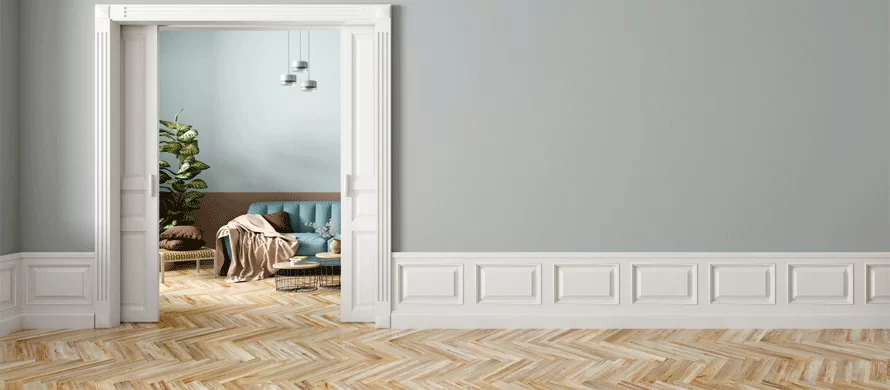
In general, regarding color combinations, a light wood paneling can enhance wooden floors of any essence; while gray is recommended to give rooms a touch of Nordic austerity.
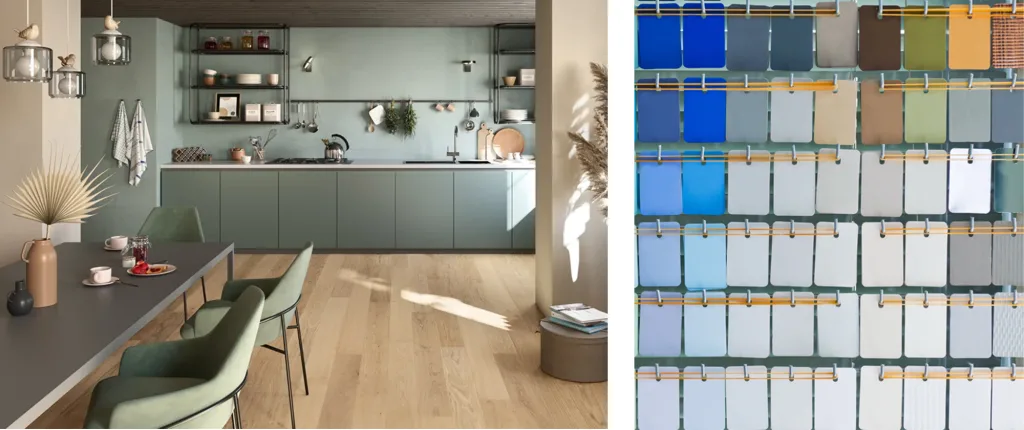
More sophisticated, but no less charming, is the choice to pair a petrol blue or green wood paneling with parquet in soft tones such as those available in the Woodco Signature line in oak or walnut.
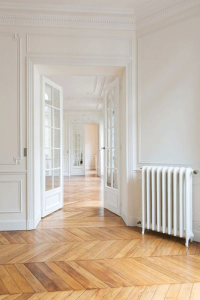
The laying styles also matter significantly. A 45-degree herringbone pattern, for example, is once again suitable for spaces with a more classic tone and light walls, where the color contrast helps to add a touch of airiness and spaciousness.
To learn about the main types of herringbone patterns, you can delve into our article: Italian, French, and Hungarian herringbone: let’s get to know them better.
Parquet and wood paneling: which laying styles to choose?
The most common pairing between parquet and wood paneling is, as mentioned, with the various herringbone patterns: 45, 60, or 90 degrees. Yet, there are ample possibilities for combinations between these two wooden protagonists.
From the classic and elegant style reminiscent of the noblest palaces, the square pattern, like those in Signature, is certainly a choice to consider, even more so if the light wood paneling is associated with natural tones like Leather Oak and Cream Oak. Additionally, choosing antique doors of the same color as the walls will further emphasize the Parisian style sought in this type of decor.
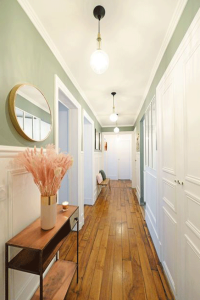
Finally, if you prefer a more linear combination, our advice is to lay the boards in the same direction as the development of the wood paneling to give the environment greater visual continuity.
Here are 10 ideas for pairing wood paneling and parquet!