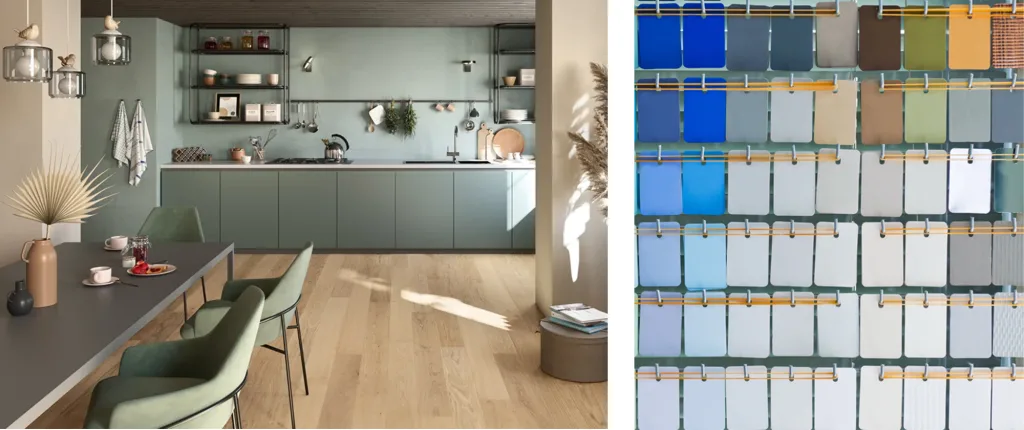


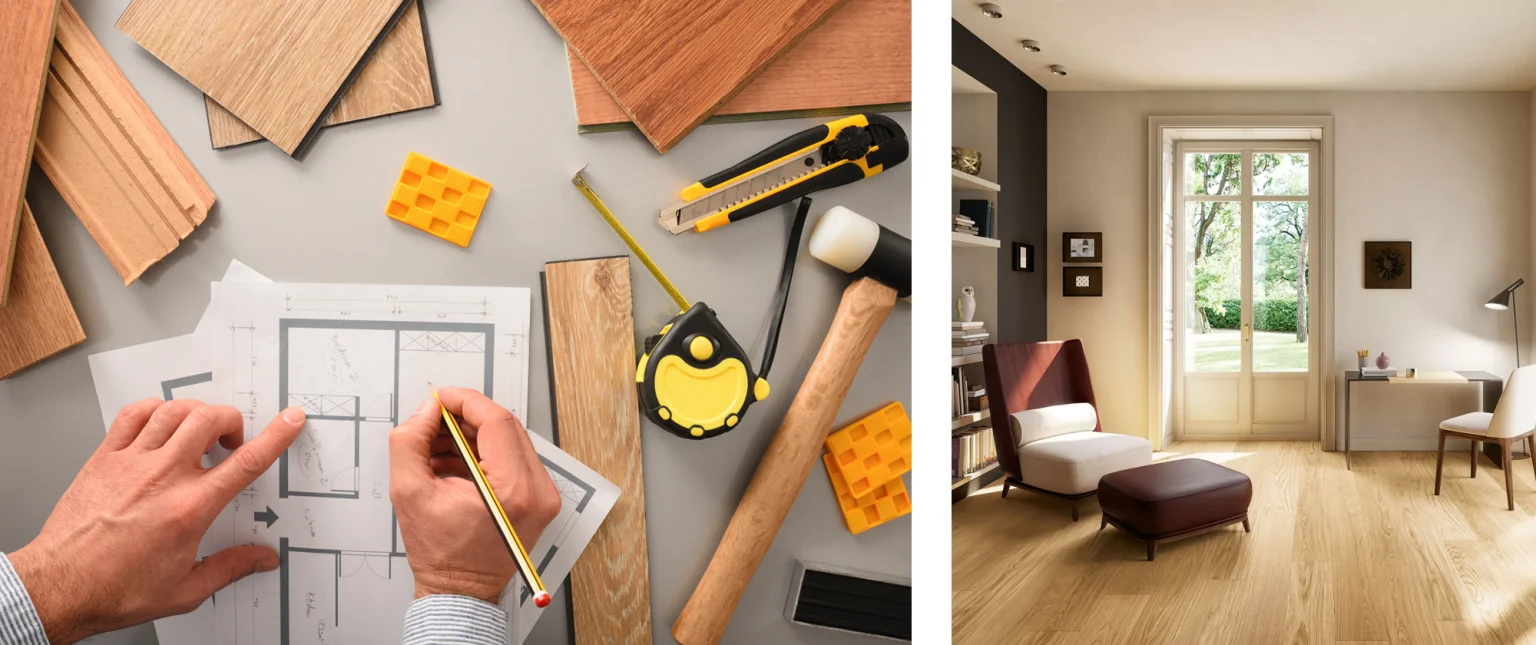
Giving your home a new look starting with the renovation of the old flooring with parquet is not a complicated task, and the details to consider before you begin the renovation are simple, especially when you rely on experienced and skilled installers.
Wood flooring: what’s underneath?
The choice of the variety of boards to lay clearly depends on your personal taste and the style you want to give to your spaces: we will discuss this further later. However, right from the start, we want to tell you that to install parquet, it is not absolutely necessary, in the vast majority of cases, to act on the existing flooring. Certainly, if there is carpet or laminate, they will need to be removed and the underlying surface properly leveled. If your floor is stone, tile, or wood, it can be covered directly and without major issues, provided that no significant unevenness or irregularities are discovered and the previous coverings are still in good condition.
Two-layer parquet and floating installation: the advantages
Our advice is to choose a two-layer parquet, as it is more versatile and suitable for being laid over your old floor, and because it can minimize the inevitable loss of height space due to the new installation. As for the installation, the floating method is certainly less invasive and costly than the glued one, it is quicker and ensures both optimal heat circulation and ideal moisture protection, also because a floating wooden floor adapts better to temperature changes. The performance of the wooden floor also improves if the boards are laid on a special underlay with an attached vapor barrier with sound-absorbing as well as thermal insulating properties.
Underfloor heating and parquet: a perfect match
The compatibility of parquet with underfloor heating systems is a common concern when choosing flooring. However, with the proper integration of the underlay and a concrete screed between the parquet and heating systems, it is possible to ensure effective heat distribution throughout the house. Modern parquet is also suitable for environments like bathrooms and kitchens, as it withstands various usage conditions well.
Windows and parquet
There is a particular aspect you need to pay close attention to if you are renovating your home or office and overlaying parquet on tiles or stone, or even on older wooden boards.
That is, inevitably, due to the installation of the new flooring and possibly the underlay, the dimensions of your space are bound to change and decrease in height. It is crucial to remember this, especially if you are purchasing new windows, as their measurements must adapt to the change.
Similarly, if the parquet is installed only in certain rooms, the installers must work to ensure a smooth and seamless transition. Otherwise, there are very few issues: the wooden floor is laid in successive stages, first in one room and then in another, and it takes at most two to three days to stabilize.
This means you will not need to relocate or completely empty the spaces where you live or work, and the inconvenience you face will be very limited in duration.
For wooden flooring, follow your style
Replacing a ceramic floor by opting for wood instead of a solution like wood-effect porcelain stoneware means making a choice of sustainability and circular economy, as we have seen in the past, but not more demanding.
Firstly, porcelain stoneware does not simplify and indeed complicates cleaning operations; and considering the installation costs, its overall cost is not far from that of genuine parquet. And for the latter, inevitably marked by the passage of time, to regain its original splendor, a simple sanding operation every 15-20 years at most is sufficient, without forgetting the necessary routine cleaning procedures with the most suitable products for your type of parquet.