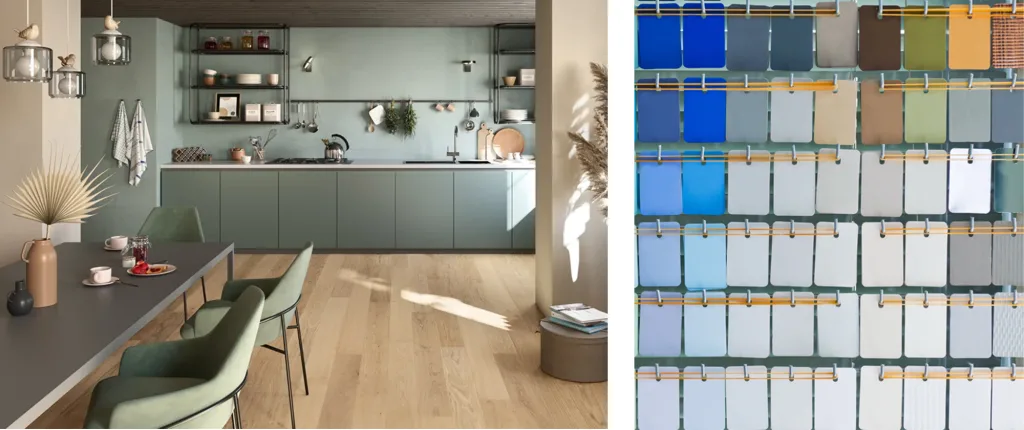


The idea that it is not possible or advisable to install parquet in the bathroom and kitchen is wrong and is the result of a prejudice we want to dispel.
It’s true: the bathroom and kitchen are the areas of the house where flooring is most likely to get wet. And water is, as is well known, among the most formidable enemies of a wooden floor, especially if too abundant and if left to stagnate for a long time. Equally true is that, regardless of the chosen surfaces, no one likes the idea of water stagnation either in the kitchen, bathroom, or elsewhere.
To ensure your parquet remains robust and aesthetically perfect everywhere, you simply need to promptly dry splashes and small puddles with a cloth, as explained in Tips on how to clean parquet.

How to protect parquet from humidity and infiltration
You might then argue that it is not so much the water itself but the persistent humidity that is particularly damaging to a wooden floor in the bathroom and kitchen.
However, this problem can also be easily overcome: make sure to ventilate the bathroom and kitchen regularly whenever steam forms. Of course, excessive humidity can be caused by significant issues such as plumbing leaks or infiltrations. For this reason, we recommend checking if your home’s system is indeed reliable, and in fact, this is one of the prerequisites for a properly executed installation. However, be aware: parquet is in full health when it is in environments with a humidity level between 45 and 60%, and in winter, with the heating on and running, dropping below this threshold is relatively easy. In this case, we suggest using a humidifier to bring the percentages back to their proper limits.
Installing parquet in the bathroom or kitchen can also be advantageous for the regular cleaning of these areas, which you should always perform first with a vacuum cleaner and then with damp cloths. This will prevent dust and mold deposits from forming in the joint gaps, as happens with tiles.
Wooden floors: the ideal installation for bathroom and kitchen
Another important detail to consider in your environments is the temperature, which should be kept as constant as possible between 15 and 22 degrees. We recommend installing parquet during the less cold periods of the year for optimal performance and suggest preferring prefinished parquet rather than raw and still to be sanded.
Even if you choose a prefinished parquet, it must still be properly treated so that the wood is isolated between the planks, to minimize the possibility of damage.
Prefer glued installation to avoid possible water infiltrations between the wood and the screed; floating or suspended installation is less recommended since, in the absence of adhesive between the flooring and the screed, it may not provide adequate protection.
Which type of parquet for bathroom or kitchen?
Certainly, a varnished parquet is better than an oiled one; apply silicone along the perimeter of the bathroom or kitchen to protect against humidity and preserve the wood’s elasticity.
Doussié, Iroko, and Teak are the most suitable types for choosing wooden flooring for the bathroom and kitchen, as they have greater stability in contact with water, but with its inherent resistance, oak can also be an excellent choice.
You can find inspiration in our Bathroom environment from the Dream series, a valid example of parquet for bathroom and kitchen in teak.