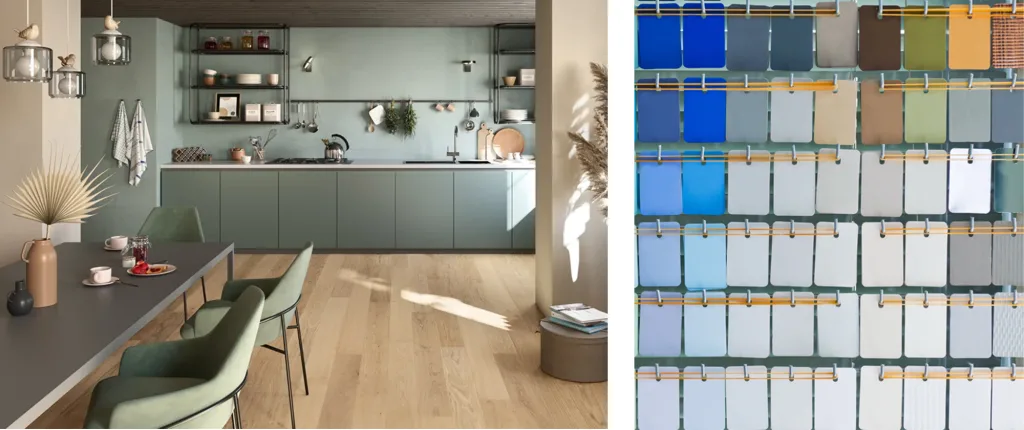


Installing new parquet, with glued or floating installation, is a very important decision to consider during home renovation projects, and therefore requires taking into account a series of aspects and precautions. For example, as you well know, demolishing and completely redoing existing surfaces is more demanding and costly than simply covering the old flooring, whether it is wood, marble, or tiles.
Among the advantages of a new installation, which is inevitable when refurbishing systems or installing underfloor heating, you certainly do not have to worry about the technical characteristics of the previous floor, such as thickness and flatness.
Laying Parquet on Existing Flooring: Before You Begin
Although it is less invasive and demanding in terms of cost and time, laying parquet on existing floors requires checking some essential points, which if not well considered, could compromise the entire installation.
First, check the solidity, stability, and flatness of the old tiles or parquet, and then make sure to identify the levels of the doors or entrance and passage doors.
Covering an Old Tiled Floor
To cover your old tiled floor with glued parquet, you must ensure that all elements adhere perfectly to the subfloor. Remove any loose tiles and level the remaining spaces, calculate the flatness with a maximum tolerance of two millimeters of unevenness every two meters, and if necessary, correct it using a self-leveling compound.
If you have a floor with rough or matte tiles, we recommend treating the surface with degreasing products, while if your tiles are smooth or glossy, use a single-brush machine equipped with a 24/36 grit disc.

Example: How to Cover Old Tiles with Floating Flooring
If you want to cover with floating or floating parquet, typical of three-layer parquet or dry-fit parquet, you must take into account the same tolerances we have just presented.
In addition to checking the adhesion with the tiles and a good initial cleaning of the surfaces, you must place a soundproofing underlay, preferably integrated with a vapor barrier, to minimize footstep noise and ensure greater comfort while avoiding potential moisture rise.
Laying Parquet on an Old Wooden Floor
For floating installation on an existing parquet, the procedure is similar to what we have presented for tiled subfloors. If you want to cover your old wooden floor with glued parquet, you must first sand the existing surface to facilitate adhesive bonding.
Among our collections, you will find a wide range of low-thickness and quick-installation solutions, such as the Dream line, a prefinished parquet collection offering three-layer boards in widths of 160, 180, and 220 mm.