

Contrary to some misconceptions, we at Woodco want to assure you that underfloor heating and parquet can perfectly coexist. If you wish to install underfloor heating systems, you can enjoy many benefits by paying attention to a few details regarding the choice of materials and installation methods.
What are radiant screeds?
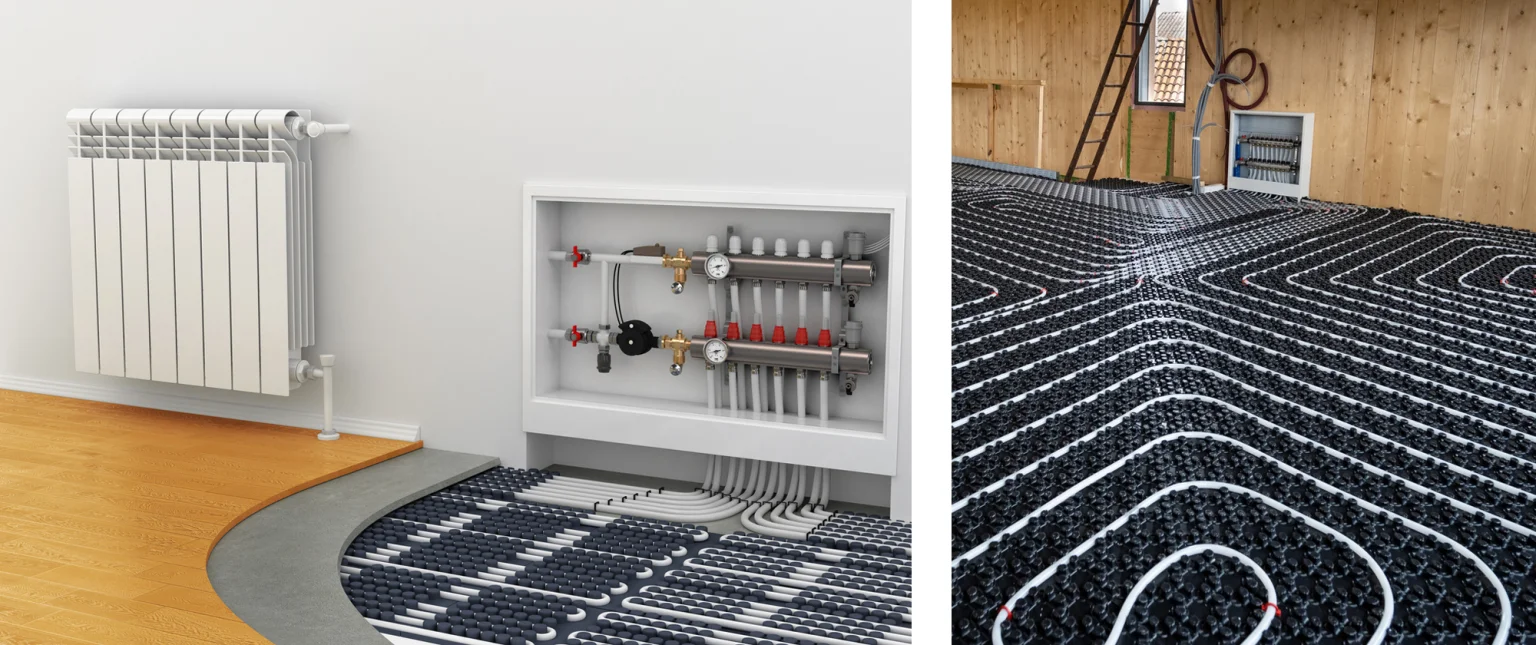
Among the most commonly used heating technologies today, we undoubtedly find the use of radiant screeds, which can be cement-based, hydraulic binders, or calcium sulfate-based (anhydrite). In simpler terms, these screeds are radiant surfaces capable of having a dual function: heating and cooling. This functionality is provided by the thermal exchange that occurs between the screed and the external environment thanks to the liquid flowing through the serpentine pipes inside them.
Most of our parquet is suitable for use on heating and/or cooling screeds, and both glued and floating installations are possible.
Before installation: the thermal shock of the screed
Choosing underfloor heating and the use of radiant screeds has a significant advantage: its large thermal exchange surface allows for excellent uniformity of distribution throughout the environment, avoiding heat peaks or, conversely, unheated areas. The transition from one room to another is no longer characterized by strong temperature fluctuations typical, for example, of traditional heating systems.
Before installation, it is important to perform a thermal shock procedure on the screed compared to normal operating conditions.
Also called the preheating cycle, the thermal shock of the screed, if carefully executed, will prevent unpleasant future issues with the parquet, such as planks and/or boards swelling or lifting.
At least three weeks before laying the parquet, it is advisable to activate the heating, gradually increasing the temperature by about 10°C per day until reaching a temperature 10°C/20°C higher than the operating temperature. This temperature should be maintained for at least 10 consecutive days. During the preheating operation, keep the rooms ventilated to promote the stabilization of the screed.
Once the thermal shock operation is completed, the cooling process follows, which consists of reducing gradually the temperature by 10°C per day until reaching the minimum temperature allowed by the system.

Which parquet installation for underfloor heating?
Most of our parquet can be installed on radiant screeds. It will be the responsibility of the thermotechnician, once the type of parquet to be installed is defined, to determine the power and characteristics of the system so that it performs well with the floor characteristics.
While many believe that glued installation is the most suitable for underfloor heating, we recommend also considering floating installation. With suitable underlays, strips of the right thickness and size, a nylon vapor barrier, and a thermal resistance of the package < 0.15 m2K/W, floating installation indeed ensures optimal heat transmission.
If you wish to perform a glued installation, great attention must be paid to the adhesives used, which, in addition to being compatible with the specific type of screed, must maintain sufficient elasticity over time to allow the parquet to move.

The perfect woods for underfloor heating
The woods that best adapt to underfloor heating are those less prone to thermal expansion and the effects of humidity, such as oak, teak, and iroko.
Discover the collection you prefer among ours, and if you have any doubts, contact us!