

Wooden floors remain a successful choice for homes and commercial spaces even today, as evidenced by the long history of parquet spanning 6,000 years.
Just last year, for example, a total of 92 million square meters of parquet was produced in Europe, and consumption exceeded 81 million square meters. These figures clearly demonstrate the great success and immense appreciation for wooden floors.
The use of wooden floors in the Old Continent is not a new discovery but the result of a story that began four millennia before Christ, when this type of surface was used both in Northern Europe and Egypt.
At that time, wood represented for local populations the most effective barrier against humidity, cold, insects… but this is merely the prehistory of parquet, which, before reaching the boom of the Seventies and Eighties, went through a series of stages that we will try to retrace together here.

Why is it called Parquet?
Let’s start from the origin of the name: why is it called parquet?
Some scholars trace its spread back to the 17th century, probably as a diminutive of the French word parc, because the precious woods used in its creation resembled those of the great gardens of the villas and courts of France.
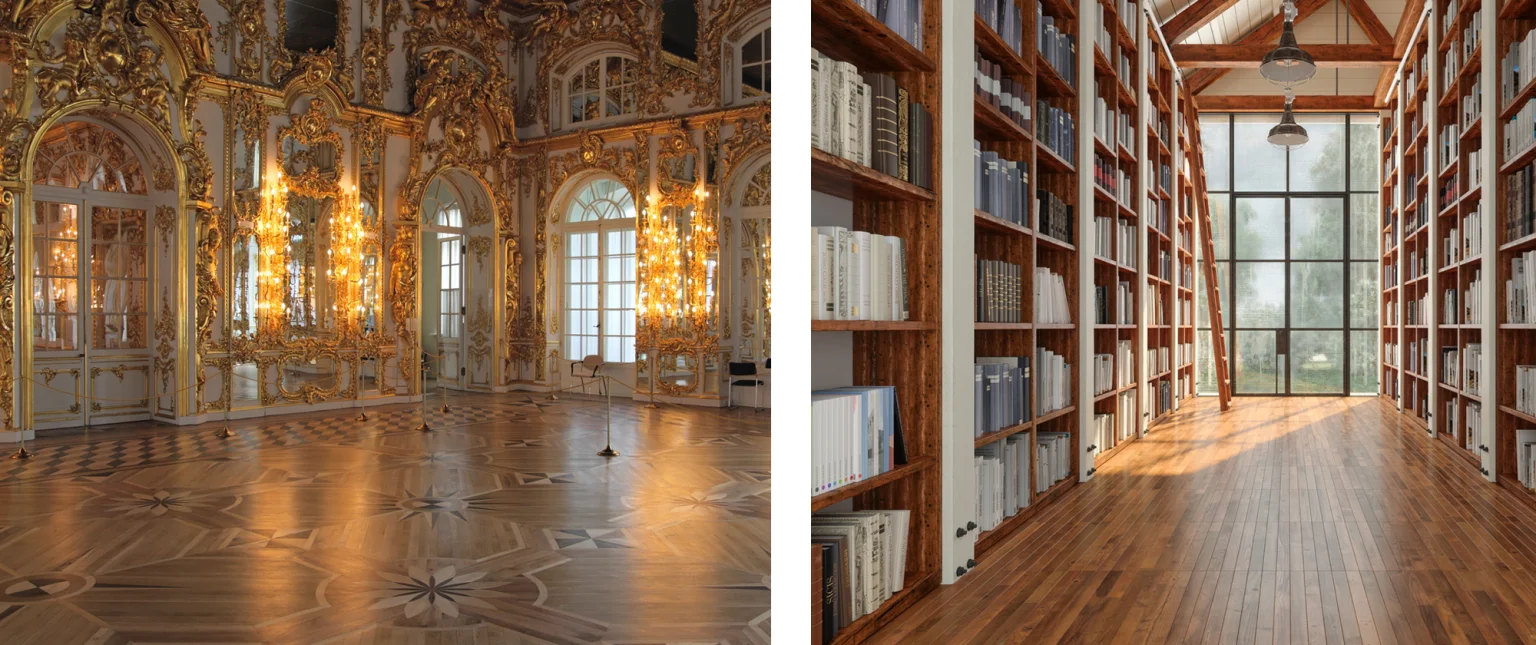
On the other hand, parquet is still synonymous with naturalness and living material like wood, and, on the other hand, the room where the Sovereign granted audience to his subjects, floored with wood, was called Parquet. In France, we also find one of the earliest significant examples of parquet as we still conceive it today. It was created specifically for King Francis I by architect Jules Menard in 1534. Remaining for a moment beyond the Alps, here walnut, cherry, and beech became the raw materials used for the floors of noble residences and the palace of Versailles, as they were easily available locally.

Parquet, inlays, and herringbone: Made in Italy has ancient origins
Even earlier, however, particularly in the decades preceding the year 1000, in northern Europe, oak, pine, fir, and larch were worked, and between the Gothic period and the fifteenth century, the trend of combining different wood species to achieve impactful color and visual effects began. Examples of these works are still visible in Scandinavia or the United Kingdom, but the creativity of Italian parquet certainly did not miss the appointment with style. In the 14th century in Tuscany, inlays began to gain popularity—especially with walnut, cypress, or fir bases—which, inherited from oriental art, became the model for parquet in subsequent centuries, in France and throughout Europe.
Imaginative combinations of olive boards and oak strips, among others, began to emerge.
From ancient Rome to modernity
Italy hosts remarkable examples of parquet even in the following centuries, of course: those signed in the 18th century by Filippo Juvarra in the Savoy hunting lodge of Stupinigi, near Turin, and, still in Turin, at Palazzo Madama, not to mention those of Ducal Palace in Venice or those in places of art and culture like the 19th-century Revoltella Museum in Trieste.
But in Italy, parquet has, in fact, returned home, as wood was anciently used to create impressive flooring even in the homes of the Roman era.
At Woodco, we are the heirs of an illustrious tradition, and many of the wood varieties seen in this post are an integral part of our offering. Some of the designs proposed recall the herringbone patterns and inlays of the distant past; and it is no coincidence that the Signature range includes the Versailles panel: because a wooden floor produced and laid to perfection is undoubtedly also a floor fit for a King.