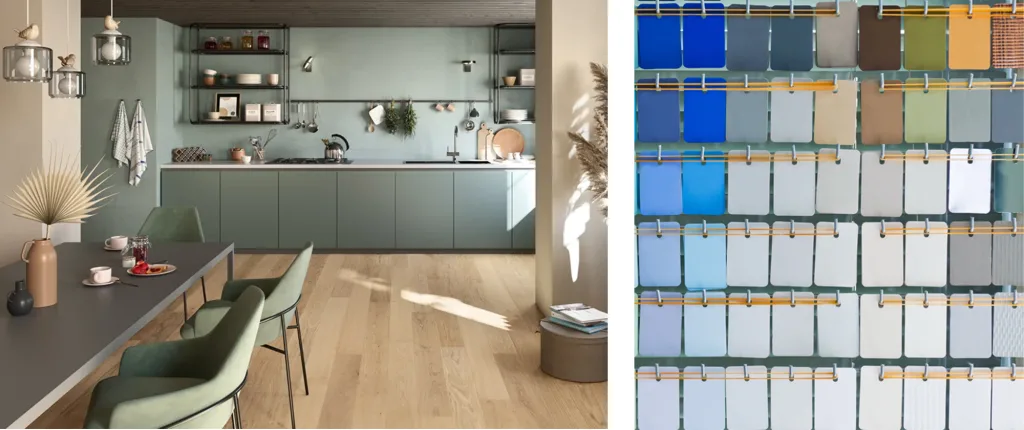


We have had the opportunity to explain to you that parquet, despite some persistent prejudices about its excessive delicacy, is a durable surface: this characteristic makes it suitable for installation even in bathrooms and kitchens.
Certainly, however, wooden flooring requires care.
In particular, we focus here on how to protect parquet from some of its worst enemies: excessive heat, temperature fluctuations, and humidity.
Balance: the best friend of wooden flooring
Not too dry, not too humid: a balanced climate and microclimate in the home are excellent defenses for your parquet.
For this reason, we recommend that once the installation is complete, you maintain the environment at a temperature between 18 and 22 degrees Celsius, and air humidity between 45 and 60%.
Starting from this last point, the reason is quickly explained: a level of humidity below 45% can cause cracks, small splits, known as fissures or fractures, the so-called hairline cracks, to form between the boards.
On the other hand, when the humidity level in the environment is above 60%, the damage consists of possible swelling phenomena.

The ideal climate for your parquet
In the winter season, the use of domestic heating systems can promote dryness in the air and home spaces and reduce the relative humidity to below 20%.
The result is that the parquet may start to warp and its boards to bow downward and detach.
In summer the problem is clearly opposite: that is, the sometimes excessive use of air conditioners tends to create conditions that favor humidity and thus the deformation of the boards.
Regularly airing out the rooms, therefore, is an excellent remedy to keep your parquet healthy.
Alternatively, you can use dehumidifiers and humidifiers; the former are certainly helpful in eliminating excess humidity and thus maintaining the wooden floor in optimal condition. The latter, on the other hand, counteract the overly dry microclimate typical of many homes during winter.
Opting for air conditioning systems that not only cool the air but also filter it and are equipped with thermostats for temperature regulation is certainly the right way to maintain constant temperatures and humidity levels inside your home with a wooden floor.

Repairing damage: a job for professionals
It is clear that the domestic microclimate is just one of the possible obstacles to the good preservation of your parquet.
For example, you might find yourself dealing with leaks and water infiltrations from pipes, walls, or roofs, or suffer from poor initial installation.
When the damage is done and the boards lift and detach, the advice is to absolutely avoid DIY.
Drying the subfloor and boards, their possible replacement or restoration through sanding are tasks you should entrust to an expert hand.
Even though prevention is naturally always better than cure, keeping in mind that if temperature and humidity levels are optimal, it benefits not only the health of the parquet but, first and foremost, yours.